
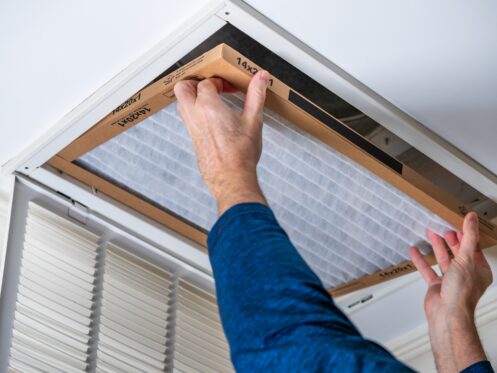
Spring pollen, summer dust, and wildfire smoke can all make indoor air feel rough in Richardson. If your eyes are irritated, your home feels dusty, or smoke haze is affecting outdoor air quality, your HVAC filter matters more than usual.
The right filter can help capture more airborne particles, but the highest-rated option is not always the best fit for every system. Understanding MERV ratings can help you choose a filter that supports cleaner air without restricting airflow to your heating and cooling system.
What MERV Ratings Actually Mean
MERV stands for Minimum Efficiency Reporting Value. It measures how well an air filter captures particles as air passes through it. The higher the MERV rating, the smaller the particles the filter can trap.
Basic filters may catch larger dust and lint particles, while higher-rated filters can capture more pollen, pet dander, fine dust, and some smoke particles. During Texas allergy season or periods of wildfire smoke, that added filtration can make a noticeable difference indoors.
Why Higher MERV Is Not Always Better
A filter with a higher MERV rating can capture more particles, but it can also create more airflow resistance. If your HVAC system is not designed for a dense filter, airflow may drop. That can make your system work harder, reduce comfort, and increase wear on equipment.
This is why filter selection should balance air quality with system performance. A MERV 13 filter may be helpful for smoke and allergy concerns, but not every system can handle it properly.
Choosing Filters for Allergies and Smoke
For many homes, filters in the MERV 8 to MERV 13 range offer a practical balance. MERV 8 filters can help with larger household particles, while MERV 11 and MERV 13 filters can capture smaller allergens and more fine particles.
You may want to consider a higher-efficiency filter if:
- Seasonal allergies are worse inside your home
- Wildfire smoke or outdoor haze affects local air quality
- You notice more dust collecting around vents
- You have pets that contribute fur or dander
- Your current filter becomes dirty quickly
When Filtration Needs More Than a Standard Filter
If smoke, allergies, or dust are ongoing problems, a standard filter may not be enough on its own. Whole-home air quality solutions can work with your HVAC system to provide more effective filtration throughout the house.
These options may include media air cleaners, upgraded filtration systems, or air purification equipment designed to capture smaller airborne particles while maintaining proper airflow.
Breathe Easier in Your Richardson Home
The best air filter for your home depends on your indoor air quality concerns, your HVAC system, and how much airflow your equipment can safely handle. At Hammack Service Company, Inc., we help homeowners throughout Richardson, TX choose filtration and indoor air quality solutions that support comfort, cleaner air, and reliable system performance.
If allergy season or wildfire smoke is affecting your indoor air quality, contact Hammack Service Company, Inc. today to schedule an evaluation.
